Is Your Dog Actually Having Fun? How to Read Play
Almost every scuffle we have prevented looked like play thirty seconds earlier. That is the uncomfortable part of group walking, and it is also the whole skill. Rough play and a fight use most of the same moves. What separates them is not how loud it is or how fast the dogs are going. It is whether both dogs still have a say.
This is the guide our walkers work from. It is written for owners, because the same read works at the park, in your kitchen, and on a hotel room floor when your dog meets the neighbour's puppy.
The one thing to remember. Good play is a conversation. Both dogs take turns, both dogs hold back, and both dogs keep pausing to check. When any one of those three drops out, the play has stopped being play, whether or not anybody has raised a lip.
What good play is made of
Researchers have spent decades filming dogs playing and coding what they do, and the same features keep showing up.
Turn taking. Erika Bauer and Barbara Smuts filmed pairs of dogs at play for a 2007 paper in Animal Behaviour and coded who chased, who got chased, who ended up underneath. Role reversals were real and common, though not evenly distributed: bigger, older or higher ranking dogs did more of the chasing and less of the holding back. Reversals also had rules. Dogs swapped roles during chases and tackles, but almost never during mounting or muzzle biting. If your dog is doing all the chasing and never gets chased, that is not automatically a crisis, but it is a thing to watch.
Holding back. Self-handicapping is a big dog going down to a small dog's level, rolling over voluntarily, mouthing with an open jaw and no pressure, or running at half the speed it is capable of. The same study found self-handicapping was linked to play signalling. Dogs who hold back are the dogs who keep saying "still playing."
Pausing. A 2016 study by Sarah-Elizabeth Byosiere, Julia Espinosa and Barbara Smuts in Behavioural Processes looked at when adult dogs actually perform a play bow. It turned out the bow usually comes after a pause, with both dogs already still, and it restarts play rather than apologising for it. That reframes the pause as the important beat. Play that never stops is play nobody is checking.
So the question we ask on the trail is not "are they being rough." It is: are they swapping, are they holding back, and are they stopping?
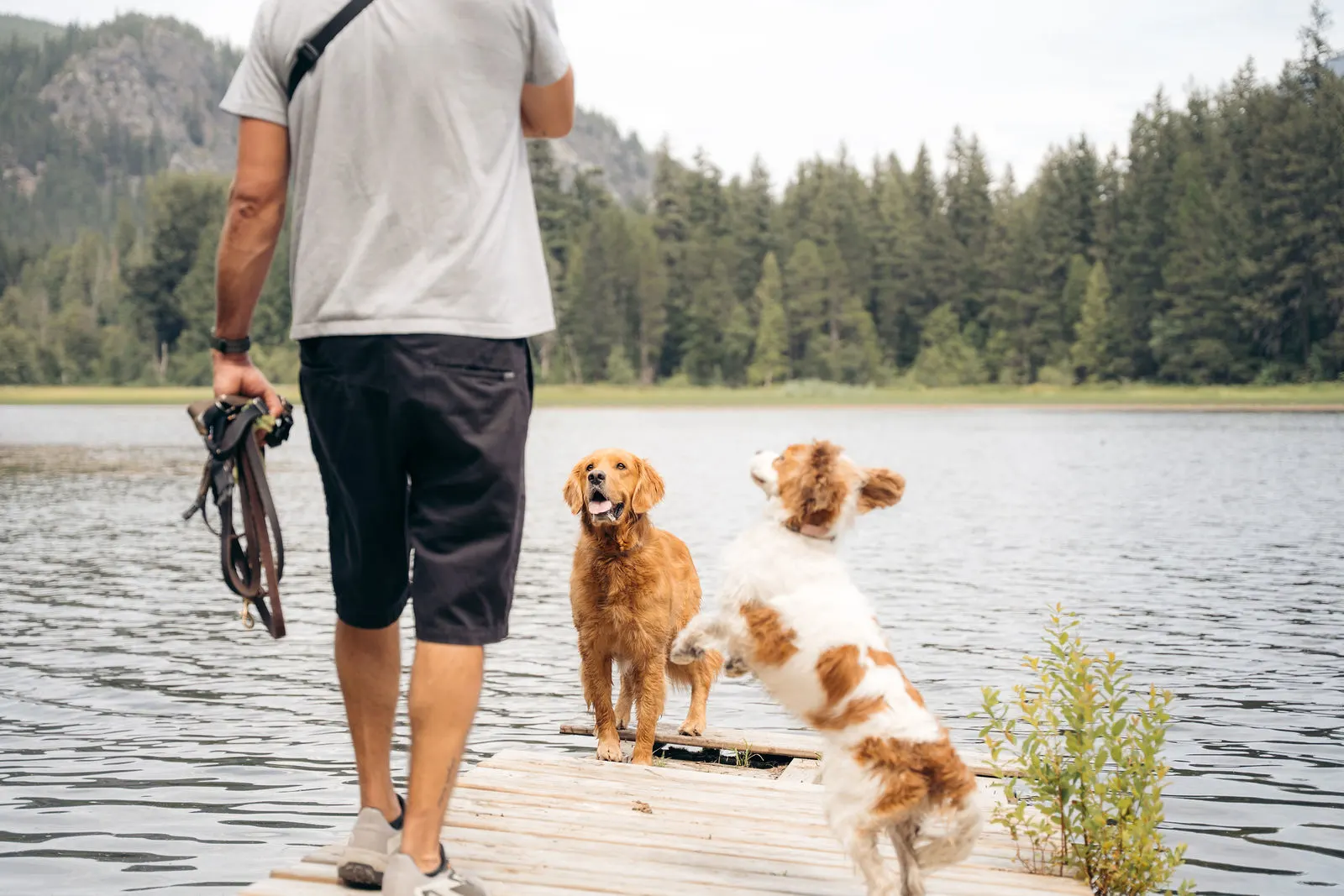
Green light: a dog having a good time
Loose is the word. A dog enjoying itself looks slightly badly assembled.
- Curves, not lines. Approaches arc rather than going straight at the other dog. Bodies are C shaped and wiggly.
- Bouncy, exaggerated movement. Play has a cartoonish quality. Movements are bigger and less efficient than they need to be. A dog moving with real economy is usually not playing.
- Play bows, especially after a break in the action.
- An open, relaxed mouth. Loose lips, often a visible tongue, sometimes a soft "play face" with the corners drawn back.
- Voluntary flopping. A dog who throws itself on its back and springs up again is choosing that position.
- Self-interruption. The dogs break off, shake, sniff something, then go again. The shake off is a reset. It is a good sign.
- Handicapping. The Labrador crouching to let the terrier win.
- Both dogs come back. After every natural break, both re-engage.
Noise is not a reliable signal on its own. Some breeds play loudly and with a lot of mouth, and a growl during play is usually just a growl during play. Read the body, not the volume.
Amber: play that is tipping
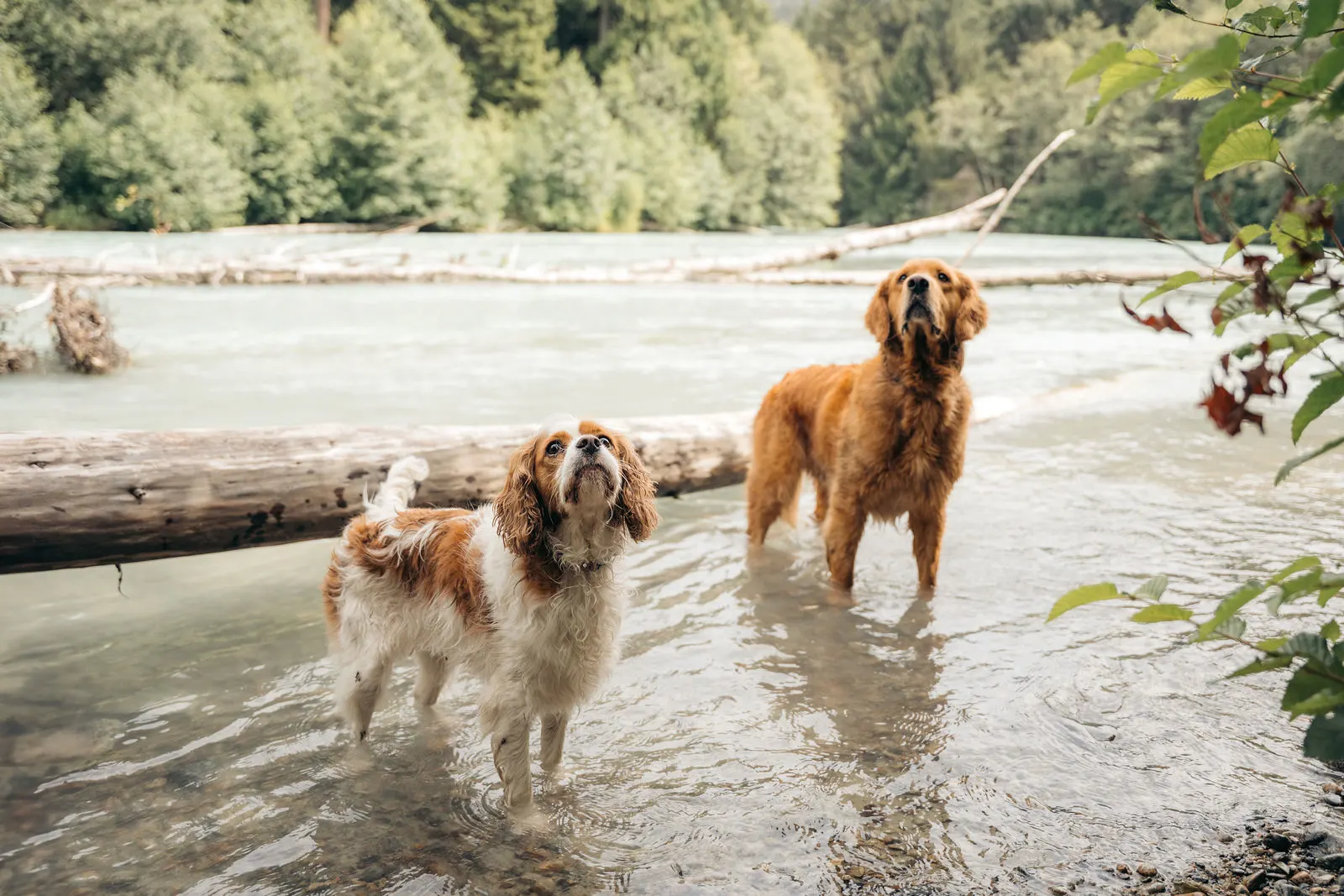
This is the stage most people miss, and it is the only stage where intervening is easy. Nothing here means stop forever. It means change the picture now, before it changes itself.
- The turn taking stops. One dog chases every time. One dog is always underneath and never on top.
- The pauses stop. Twenty minutes of unbroken chase is not a good sign, it is a dog who cannot come down.
- Stiffness creeps in. Movement gets efficient and straight. The C shape goes out of the body.
- A pin that does not release. Brief pins are normal. A dog standing over another dog, still, for several seconds is not playing.
- Freezing. A hard still moment in the middle of motion is one of the loudest warnings a dog gives, and it is almost always the last one before contact.
- Hard staring. Fixed, unblinking, aimed at the other dog rather than past it.
- Recruitment. A third and fourth dog joining a chase. Group chases escalate faster than anything else in a pack, and a dog being pursued by three others is being hunted, not played with.
- Hackles up plus stiff. Raised hackles on their own are arousal and can appear in perfectly good play. Raised hackles with a stiff body and a hard stare are different.
- Mouthing gets harder. Open jaw becomes a grip. Play bites move from the neck and shoulders to the legs and the base of the tail.
- Repeated mounting. Especially when it is one direction only and the other dog keeps moving away.
On our walks, amber is where the walker's voice comes in. A recall, a change of direction, a short sit, thirty seconds of nothing. Almost every one of these resolves in under a minute if you catch it here.
Red: end it now
Stop the interaction, add distance, and do not put those two dogs straight back together.
- A dog is actively trying to leave and the other dog will not let it.
- The chased dog is screaming, tucking, or trying to get behind a person.
- Sustained pinning with a hard mouth on the neck.
- Lifted lip with a closed mouth, or a low growl with a stiff body.
- A dog is going still and quiet while the other dog escalates.
- Anything you have seen twice already this walk.
Splitting dogs up is done with body and movement, not hands. We step in between, call the dogs away from each other, and change direction. Reaching into two aroused dogs is how people get bitten by dogs who like them.
The consent test
This is the single most useful thing an owner can learn, and it takes five seconds.
Gently hold or call back the dog who is doing more of the chasing, mounting, or pinning. Let go after a couple of seconds. Then watch the other dog.
If the other dog bounces back in, bows, or re-invites, you have a yes. Both dogs are consenting and you can let it run. If the other dog shakes off and walks away, sniffs the ground, moves behind you, or looks visibly relieved, you have a no. The play was one sided and you just found out cheaply.
The idea is well established in the training world. The IAABC Foundation Journal describes running these checks frequently rather than once, precisely because the answer changes as dogs get tired. A dog who consented at minute two is often done by minute fifteen.
Run it every few minutes with any new pairing. Run it whenever there is a size or age gap. Run it any time you are not sure, because "I was not sure" is the most common sentence we hear after something goes wrong.
The dog who is not having a good time
Owners rarely miss a fight. What they miss is the dog who is coping.
Dogs do not usually snap first. They ask, quietly, in a language Norwegian trainer Turid Rugaas popularised as calming signals: lip licking away from food, a big out of context yawn, turning the head or the whole body away, sniffing the ground with sudden intensity, a slow blink, scratching when there is no itch. Our guide to tail, ear and stance signals covers these in more detail.
In play specifically, the ones we watch hardest are these.
Whale eye. The head turns away but the eyes stay locked on the other dog, showing a crescent of white. This is a dog tracking a threat while trying to look non-threatening.
The tucked tail sprinter. A dog running fast with its tail clamped and its ears back is not playing chase. It is fleeing, and the dogs behind it read that as prey rather than as an invitation.
The dog who keeps hiding behind you. This is the clearest sentence a dog has. If your dog comes to you three times and you send it back into the game each time, you are teaching it that asking does not work.
The frozen roll. A dog on its back, rigid, mouth closed, head turned away, tail tucked. It looks like play from a distance. A playful roll is loose and wriggly and the dog gets up on its own.
Displacement scratching and sniffing. A dog who suddenly has to inspect one patch of dirt in the middle of a social situation is buying itself a break.
Overheating and refusing to stop. High arousal masks exhaustion. A dog that is panting hard, eyes wide, unable to settle and still going is not enjoying itself any more, it just cannot get off the ride. That is where injuries happen, and in summer it is also where heat trouble starts.
What we do with all this
Group walking is the reason this matters to us. Six dogs off leash on a Whistler trail is a live social situation, and someone has to be responsible for it. That someone is the walker, and it is most of the job.
Three things we hold to on every walk, and we have written them down on our services page so a client can hold us to them:
Play runs on consent. New pairings get consent tested. If one dog is not opting back in, we change the picture rather than hoping it settles.
Play has to go both ways. If a pairing has stopped swapping roles, we split it up and re-form it later. One sided play is where bullying starts, and the dog on the receiving end is the one who ends up unable to cope with a group two years from now.
Everybody comes down before they need to. We build forced settles into the walk, before arousal peaks rather than after. Long warm up on leash, then off leash time, then a break. A pack that has been running flat out for forty minutes cannot make good decisions, and neither can a person.
We are not trainers. When a dog needs training rather than management, we say so and point at Modern Dog Training. What we are is a team who watches dogs for a living, six days a week, on the same trails, in the same groups, for years. That is where this guide came from.
Want your dog read this closely every week?
Our small pack walks cap at six dogs per walker, run with the same group most weeks, and every walker is trained to read exactly what is on this page.
Sources: Bauer & Smuts, Animal Behaviour (2007); Byosiere, Espinosa & Smuts, Behavioural Processes (2016); IAABC Foundation Journal; Turid Rugaas, On Talking Terms With Dogs: Calming Signals. Doggy Tales Whistler walkers hold DogSafe Canine First Aid and Fear Free certification and work to the Pet Professional Guild force free standard. This guide reflects our field experience and is not a substitute for a qualified trainer or veterinary behaviourist.